Delhi free solar scheme 2026: who gets a free 3 kW system (the 400-unit rule)
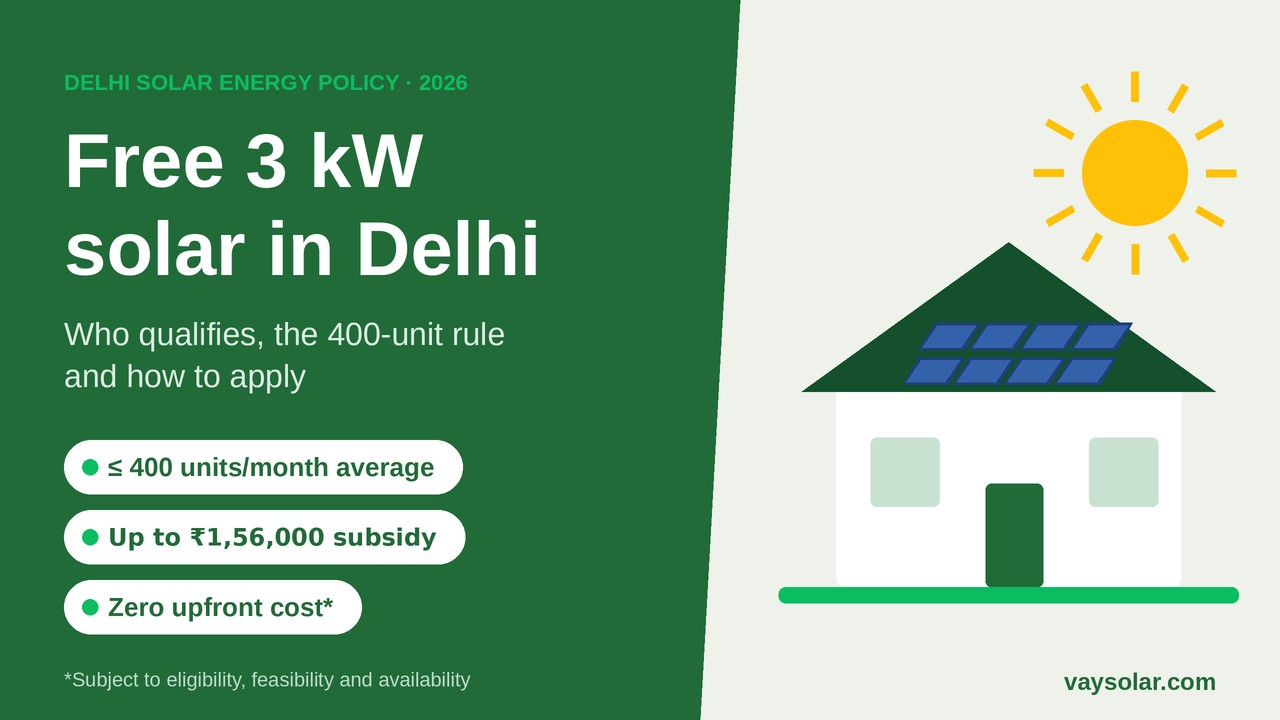
Delhi's solar policy now offers rooftop solar at zero upfront cost, but only to some households. The dividing line is a single number: an average of 400 units a month. Below it, the Delhi government bridges the cost of a system up to 3 kW. Above it, you still get a large subsidy but pay the balance.
This guide explains who qualifies for free solar in Delhi, how the 400-unit rule is worked out (including the gross-consumption catch), what "free" does and does not cover, how to apply, and how to avoid "free solar" scams.
Last updated: 19 October 2026 This guide reflects the Second Amendment to the Delhi Solar Energy Policy 2023, notified on 17 September 2026. Vendor empanelment and allocation are still moving, so confirm current status on the Delhi Solar Portal and the PM Surya Ghar portal before you apply. The Delhi Solar Portal homepage showed 97,925 total applications on 18 October 2026, against a first-come, first-served limit of 2,20,000 eligible consumers.
Want numbers for your own bill? Try our free Solar ROI Calculator.
Quick answer: free solar in Delhi, 2026
- Is it free? Yes, for eligible households: a system up to 3 kW at zero upfront cost. It is not automatic for everyone.
- The 400-unit rule: your average monthly gross consumption in the previous financial year (FY 2025-26) must be up to 400 units.
- Other conditions: no earlier solar subsidy under PM Surya Ghar or the Delhi Solar Scheme, and a technically feasible roof.
- How it adds up: central ₹78,000 plus Delhi ₹78,000, with a top-up where the tendered cost is higher. In the notification's ₹1,75,000 example the top-up is ₹19,000, so you pay nothing.
- Above 400 units: not free. You still claim up to ₹1,56,000 combined and pay the balance.
- It is first-come, first-served, so do not wait to gather your paperwork.
- Never pay an agent a registration fee to "reserve" a slot.
Is rooftop solar really free in Delhi? What is and is not covered
"Free" has limits. This is how the scheme reads for an eligible household:
| Item | Covered for an eligible household? |
|---|---|
| Solar system up to 3 kW (panels, inverter, structure, wiring, installation) | Yes, after central and Delhi subsidies plus any top-up |
| Capacity above 3 kW | No. It is at your cost, and no extra subsidy is paid |
| Roof strengthening, waterproofing or an elevated structure | Not confirmed as covered. Ask the vendor to state it in writing |
| Operation and maintenance | The DISCOM Trusteeship Model includes a mandatory 5-year O&M period. Confirm the terms for your allotted model |
| Ownership | Under the Trusteeship Model, the plant is owned by the Power Department for the first 5 years and then transfers to you |
| Electricity bill | You pay for any net units outside the subsidised slabs |
For the full subsidy maths and both implementation models, see our Delhi solar subsidy guide. For the national picture, read rooftop solar subsidies in India 2026.
The 400-unit rule explained
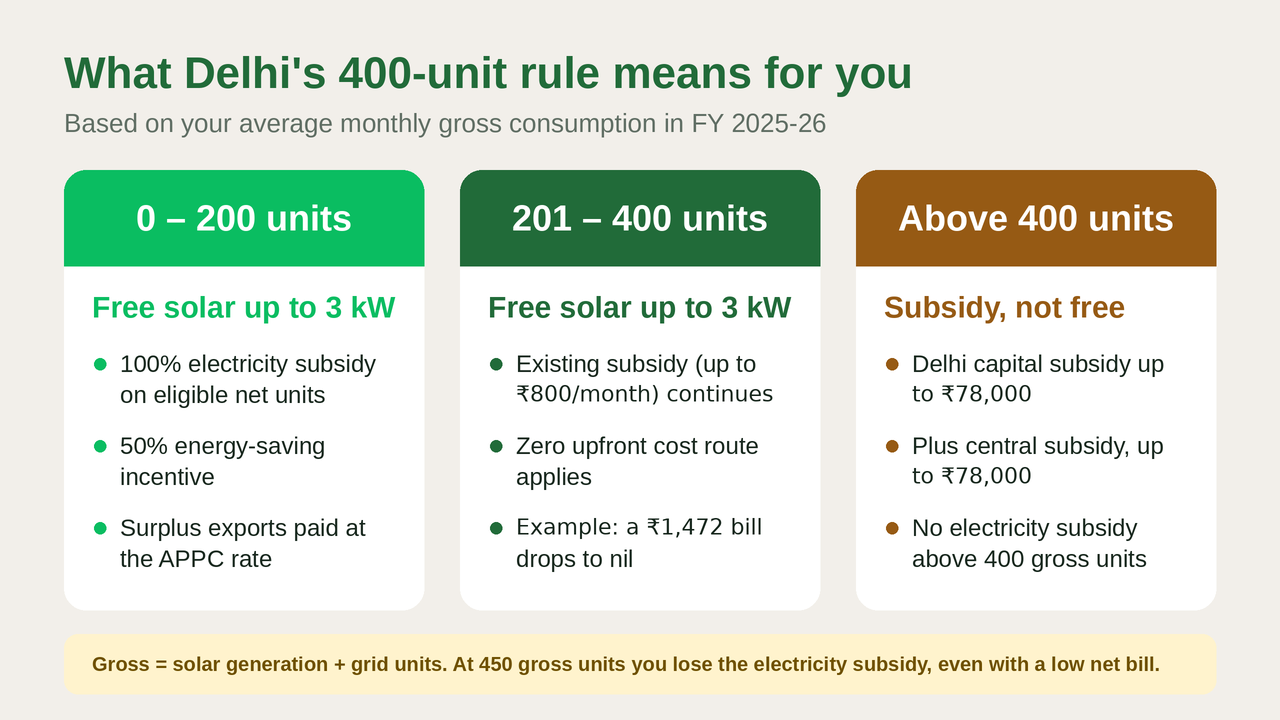
The rule looks only at your average monthly gross consumption in the previous financial year. It is an average across the year, not a cap on any single month, and "gross" means total units used, including anything your own solar would generate.
| Average monthly gross consumption (FY 2025-26) | What the policy offers |
|---|---|
| 0 to 200 units | Free rooftop solar up to 3 kW, 100% electricity subsidy on eligible net consumption, a 50% energy-saving incentive, and payment for surplus exported units at the applicable APPC rate |
| 201 to 400 units | Free rooftop solar up to 3 kW; the existing electricity subsidy (up to ₹800 a month) continues, subject to the rules |
| Above 400 units | Enhanced capital subsidy up to ₹78,000; electricity subsidy is not available where gross consumption exceeds 400 units |
How to work out your average
- Download your 12 bills for April 2025 to March 2026 from your DISCOM's app or website.
- Add up the units consumed.
- Divide the total by 12.
The yearly average is what matters, so heavy summer AC use does not automatically disqualify you:
| Summer (5 months) | Rest of year (7 months) | Yearly total | Average | Result | |
|---|---|---|---|---|---|
| Home A | 620 units a month | 200 units a month | 4,500 | 375 | Within the 400-unit limit |
| Home B | 700 units a month | 215 units a month | 5,005 | about 417 | Above the limit |
These two homes are illustrative. Check your own bills, and confirm on the Delhi Solar Portal how your figure is verified.
The gross-consumption catch
Delhi now assesses electricity subsidy eligibility on gross consumption (your solar generation plus net grid units), not on the net units on your bill. The notification's own example shows why it matters:
| Particulars | Value |
|---|---|
| Monthly consumption before solar | 450 units |
| Rooftop solar capacity | 3 kW |
| Monthly solar generation | 300 units |
| Net metered consumption after solar | 150 units |
| Electricity bill for 150 units | ₹820 |
| Electricity subsidy | Nil |
The household is billed for only 150 units, but its gross consumption of 450 units is above 400, so it loses the subsidy. If your summer months run well above 400 gross units even though your yearly average is under it, ask your DISCOM how the electricity subsidy will apply in those months before you commit. Billing itself still runs on net metering; read our net metering in Delhi guide for how that works.
⚠️ Do not size by guesswork near the 400-unit line. A few extra units of gross consumption can move you from a free system to a part-paid one.
Who qualifies for free solar in Delhi: the checklist
| Condition | What it means |
|---|---|
| Residential consumer | The connection is a domestic one, in your name. Only the registered connection holder can apply |
| Average gross consumption up to 400 units | Measured over FY 2025-26 (see above) |
| No earlier solar subsidy | You have not availed a subsidy under PM Surya Ghar or the Delhi Solar Scheme |
| System up to 3 kW | The free route covers up to 3 kW |
| Technically feasible roof | Enough shadow-free space; the DISCOM verifies your load and roof |
| DCR-compliant modules | Modules with Indian cells, which your allotted vendor must supply |
| Tenants | A no-objection certificate from the owner, and the DISCOM account must be in the applicant's name |
What if you do not qualify for the free route?
| Your situation | Your best route |
|---|---|
| Above 400 units a month | Central subsidy up to ₹78,000 plus Delhi subsidy up to ₹78,000. Under ULA your contribution is capped at ₹5,000 per kW; if the discovered cost is higher, the Trusteeship Model applies and you pay project cost minus state subsidy (₹19,000 in the notification's ₹1,75,000 example) |
| Already took a solar subsidy | You are outside the zero-upfront route. Check the Delhi Solar Portal's model list for what else applies |
| Limited roof space or a flat | Community solar or group net metering. See our group and virtual net metering guide |
| Housing society or RWA | Central ₹18,000 per kW plus Delhi up to ₹11,000 per kW for common areas |
| Want more than 3 kW | The extra capacity is at your cost. Compare prices in our Delhi installation cost guide |
What free solar can save you
The notification gives two illustrative cases for eligible households:
- Below 200 units: a household averaging 150 gross units with a 2 kW system could see roughly ₹550 a month in extra credited value, from surplus export at the APPC rate plus the savings incentive, while staying in the zero-bill category.
- 201 to 400 units: a 3 kW example takes a ₹1,472 monthly bill (after the existing ₹800 subsidy) to roughly nil, because the net units fall within the subsidised slab.
These are illustrations, not guarantees. To see where your own bill goes, read our Delhi electricity bill breakdown.
How to apply for free solar in Delhi
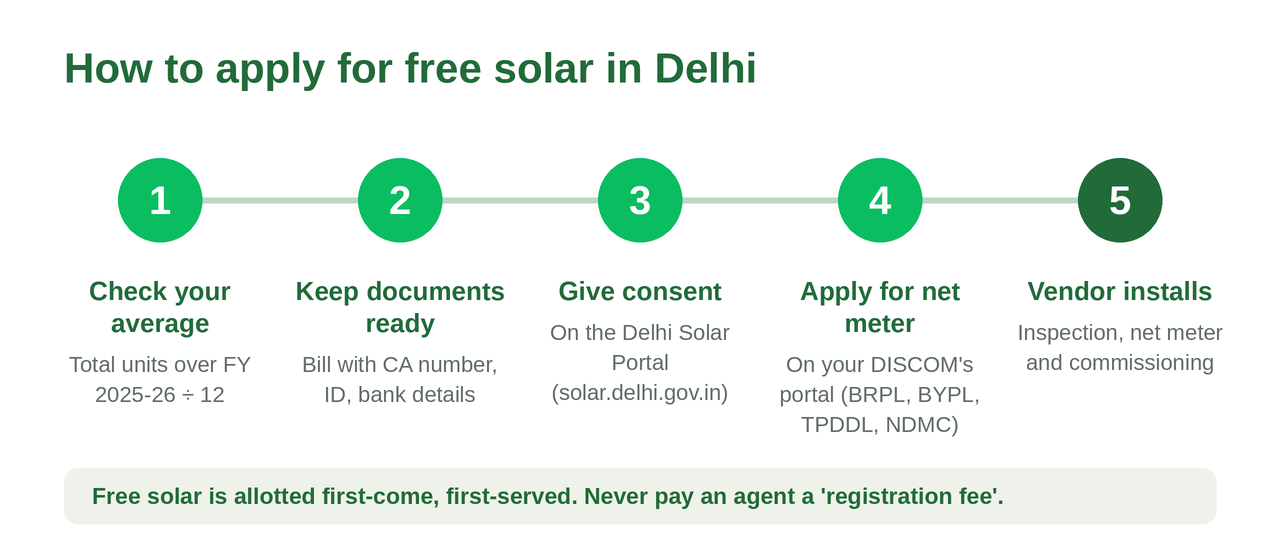
- Check your average. Work out your FY 2025-26 average gross consumption.
- Keep documents ready. Latest bill with your CA (Consumer Account) number, Aadhaar or PAN, bank details, and property ownership proof or the owner's consent letter.
- Give consent on the Delhi Solar Portal. Select your DISCOM and your preferred capacity (2 kW or 3 kW). The portal opened submissions on 21 September 2026.
- Apply for a net meter on your DISCOM's portal.
- Allocated vendor installs. The DISCOM verifies load and roof, the vendor installs, and the DISCOM inspects and fits a bi-directional meter. See our installation process guide.
To track the money, use the Capital Subsidy Released Status page on the Delhi Solar Portal with your CA number. Under the new models the subsidy goes to the vendor, so the status reflects the vendor payout, not a credit to you. If your name differs across bill, ID and bank, fix it first; our BRPL name correction guide explains how.
Which DISCOM handles your area?
Applying through the wrong DISCOM is a common cause of delay. Find your area, then confirm the company named on your bill.
| DISCOM | Areas covered by our locality guides |
|---|---|
| BSES Rajdhani (BRPL) | Janakpuri, Vikas Puri, Paschim Vihar, Tilak Nagar, Vasant Kunj, Vasant Vihar, Hauz Khas, Greater Kailash, Kailash Colony |
| BSES Yamuna (BYPL) | Laxmi Nagar, Preet Vihar, Mayur Vihar, Shahdara, Karol Bagh (mixed coverage, check your bill) |
| Tata Power-DDL (TPDDL) | Rohini, Pitampura, Model Town, Tri Nagar, Shalimar Bagh, Civil Lines, Ashok Vihar |
| NDMC | Barakhamba Road |
Browse every locality on our rooftop solar installation in Delhi page.
⏳ Timeline: why slots matter
| Date | What happens |
|---|---|
| 1 Sep 2026 | Delhi Cabinet approves the amendment, as reported |
| 17 Sep 2026 | Second Amendment notified in the Delhi Gazette |
| 21 Sep 2026 | Delhi Solar Portal opens submissions |
| 18 Oct 2026 | Portal homepage shows 97,925 total applications; limit is the first 2,20,000 eligible consumers |
| Mid-Nov 2026 (expected) | Vendor empanelment due within 45 days of notification, subject to approvals |
| 28 Feb 2027 | End of the initial Utility-Led Aggregation phase (up to 1.10 lakh installations) |
| 31 Mar 2027 | PM Surya Ghar scheduled end. The zero-upfront route relies partly on central subsidy and would be reviewed if the scheme is not extended |
The 97,925 figure is the portal's overall application counter and may include routes other than the free one, so treat it as a signal of demand rather than a count of remaining free slots.
⚠️ Free solar scams and what to ask before you sign
- Nobody should charge you to register, survey or "reserve" a slot. Apply only on the official portals, solar.delhi.gov.in and pmsuryaghar.gov.in. Check the web address before you enter any details.
- Ignore door-to-door and WhatsApp "free solar agents" who promise guaranteed approval. Allocation runs through the official process.
- Verify the vendor on the official empanelled lists, and never share OTPs.
- Ask for the scope in writing: system size, panel and inverter make, DCR certificate, what is included, and who pays for any roof work.
- Ask who owns the plant and who maintains it for the first 5 years, and what happens afterwards.
- Ask about the timeline for DISCOM inspection and net metering.
Our guides on common buying pitfalls and choosing an installer cover more of what to check.
If you are looking for rooftop solar installation in Delhi, VaySolar can help you check eligibility, size the system and handle the paperwork. Start with the locality nearest you, such as Janakpuri, Rohini, Laxmi Nagar or Hauz Khas, or see our overview of the benefits of rooftop solar.
Check my free solar eligibility
Related guides
- Rooftop solar subsidies in India 2026: central, Delhi and NCR guide
- Delhi solar subsidy 2026: amount, eligibility and how to apply
- Net metering in Delhi: process, documents and timeline
- Solar installation cost in Delhi: 3 kW, 5 kW and 10 kW prices
- Why going solar now makes financial sense
Frequently asked questions
Is rooftop solar really free in Delhi?
It is free for eligible households. Under the Second Amendment to the Delhi Solar Energy Policy 2023, households averaging up to 400 units a month in the previous financial year, with no earlier solar subsidy and a feasible roof, can get a system up to 3 kW at zero upfront cost. It is not automatic for every household, and allocation is first-come, first-served.
Who is eligible for free solar in Delhi?
You must be a residential consumer whose average monthly gross electricity consumption was up to 400 units in the previous financial year, have not availed any solar subsidy under PM Surya Ghar or the Delhi Solar Scheme, want a system of up to 3 kW, and have a technically feasible roof. Only the registered electricity-connection holder can apply.
How is the 400-unit limit calculated?
It is your average monthly gross consumption over the previous financial year (FY 2025-26). Add up the units on your 12 bills and divide by 12. Gross consumption means the units you used in total, including anything your own solar system generates, not only the net units billed.
My summer bills are above 400 units. Can I still qualify?
Possibly. The test is the yearly average, not a single month, so a home with high summer bills and low winter bills can still average 400 units or less. Separately, the electricity subsidy is assessed on gross monthly consumption, so ask your DISCOM how it will apply in months when your gross units exceed 400.
What if my consumption is above 400 units a month?
You are outside the zero-upfront route but can still claim the central PM Surya Ghar subsidy of up to ₹78,000 and the Delhi capital subsidy of up to ₹78,000, then pay the balance. In the notification's worked examples the balance for a 3 kW system ranges from ₹0 to ₹19,000. Electricity subsidy is not available where gross consumption exceeds 400 units.
Can I get free solar if I have already taken a solar subsidy?
No. The zero-upfront route is for households that have not previously availed a solar subsidy under PM Surya Ghar or the Delhi Solar Scheme.
Can tenants apply for free solar in Delhi?
Only the registered electricity-connection holder can apply. A tenant needs a no-objection certificate from the property owner and must hold the DISCOM account.
How do I apply for free solar in Delhi?
Give consent and your preferred capacity on the Delhi Solar Portal (solar.delhi.gov.in), then apply for a net meter on your DISCOM's portal. Allocated vendors then handle feasibility, installation and commissioning. Keep your latest bill with your CA number, ID, bank details and ownership proof or owner consent ready.
Do I have to pay a registration fee or agent fee?
Applications are made on the official portals. We are not aware of any registration fee for the zero-contribution category, so treat any agent who asks for money to reserve your slot as a red flag, and verify vendors on the official lists.
How long will free solar slots last?
Benefits are allotted first-come, first-served. The Delhi Solar Portal homepage showed 97,925 total applications on 18 October 2026 against a limit of 2,20,000 eligible consumers, and the initial phase under the Utility-Led Aggregation model is planned for up to 1.10 lakh installations through 28 February 2027. PM Surya Ghar is currently scheduled to run until 31 March 2027.
Last updated: 19 Oct 2026 Sources: Delhi Solar Portal (solar.delhi.gov.in), including its homepage application counter of 18 October 2026 and the Power Department's consumer guide to the Second Amendment; Delhi Gazette, Extraordinary, Part IV, No. 277, 17 September 2026, Delhi Solar Energy Policy 2023 (Second Amendment); PM Surya Ghar: Muft Bijli Yojana portal (pmsuryaghar.gov.in); news reports of the Delhi Cabinet decision of 1 September 2026.