Is solar right for you?
How much would solar cost?
On average, 1 kWp (kilowatt peak) can be installed on ~100 square feet of available area. A 1 kWp solar plant typically costs ₹65,000 to ₹85,000 depending on the quality and technology of solar panels, materials used, AMC provided, and the services and documentation offered by the installation partner. Per-kW cost generally decreases for larger systems.
Cost of a rooftop solar system depends on the below factors:
- Plant size
- Type of panels
- Mounting structure (see the mounting structure guide for a technical breakdown by roof type)
- Backup required
- Services offered
- Subsidy applicable
For the full cost table by system size (1 kWp to 15 kWp) and a breakdown of central vs. state subsidy, see Cost of Rooftop Solar at Home. For how much this translates to in bill savings and long-term ROI, see Benefits of Rooftop Solar at Home.
Choosing Plant Size
An appropriate plant size is chosen based on multiple factors:
- Electricity consumption profile
- Current sanctioned load
- Roof area available
It is advisable to go for a system that would completely offset your electricity bill's variable charges and save taxes paid on them.
The following information is used to size a solar plant:
- Annual energy usage (say 4,500 units a year)
- Daily average peak sun hours for production (in India, this is 4–5 hours per day)
- Calculate perfect system size for AC loads: 4,500 units ÷ (365 days × 4 hours of sunlight × 1 kW) = 3.08 kWh per day
- Calculate rooftop solar plant size: 3.08 kWh ÷ 80% = 3.8 kW ≈ 4 kW system
- Assess whether the rooftop area can accommodate a plant of this calculated size
- Some State Electricity Boards (SEBs) mandate that a plant cannot exceed the sanctioned load of the current connection
Choose Type of Panels
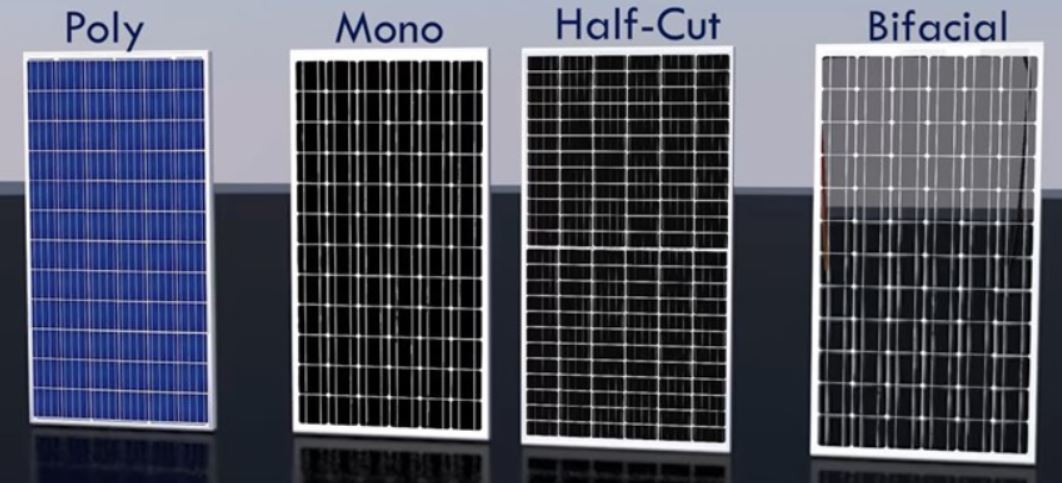
| Factors | Mono PERC | TOPCon | HJT (Heterojunction) |
|---|---|---|---|
| Efficiency | 18–21% | 21–22.5% | 22–23.5% |
| Daily Generation (per kW) | 4.3–4.7 units | 4.6–5.0 units | 4.8–5.2 units |
| Area Required | 4.5–6.0 sq. m. per kW | 4.0–5.5 sq. m. per kW | 4.0–5.0 sq. m. per kW |
| Typical Panel Size | 500–660W | 540–700W | 540–710W |
| Temperature Coefficient | −0.35%/°C | −0.30 to −0.32%/°C | −0.25 to −0.27%/°C (best in class) |
| Degradation Rate | ~0.55%/year | ~0.4–0.5%/year | ~0.25–0.3%/year (lowest) |
| Look | Black or dark blue front | Sleek black, newer design | Glass-glass design, silver/black edge |
| Best For | Value buyers with decent space | High-efficiency + limited space | Premium homes, long-term ROI focus |
Backup Required (Should I get batteries?)
Battery requirement is driven by the following factors:
See how rooftop solar works for a full comparison of on-grid, off-grid, and hybrid system types.
Services Offered
Various solar installers offer a package of services with the installation, in forms such as:
- Warranties on the solar plant and installed components
- Free annual maintenance costs/services
- Insurance on the solar plant
- Elevated mounting structures (see the mounting structure guide for material and clearance specifications by roof type)
- Preferential payment terms
- DISCOM documentation and approvals
- Subsidy documentation and approvals
- Free cables
- Remote monitoring systems
You can see a considerable difference in prices for seemingly the same kind of solar plant, and most of the time the difference arises from offering one or more of the above services. As a customer, it's important to look closely at the entire proposal so you understand exactly what you're buying — price alone can be misleading. See how to get and compare quotes for a structured approach to this.
Subsidy on Rooftop Solar
For residential customers, the Ministry of New and Renewable Energy (MNRE) provides ₹30,000 per kW subsidy on plants up to 2 kW, and ₹18,000 per kW on additional capacity up to 3 kW. Total subsidy for a connection is capped at ₹78,000.
Eligibility
- CFA/subsidy is applicable only for projects applied on the National Portal on/after 30.07.2022
- Applications are processed for technical feasibility approval and installation of the rooftop solar (RTS) plant by registered vendors
- The plant capacity eligible for CFA/subsidy is calculated after factoring in capacity already installed
- It is essential to install the rooftop solar plant through registered vendors of the concerned DISCOM
- Installation must follow the guidelines and technical specifications issued by MNRE
- Only indigenously manufactured (ALMM-listed) solar panels/modules — both cells and modules made in India — may be used
Under the current procedure, this subsidy is credited directly to the customer's bank account upon submission of relevant documentation and approvals. A consumer can choose to send surplus electricity generated by the solar plant back to the grid and pay electricity bills only for net usage — enabled by net meters installed by the electricity distribution company (DISCOM).
State Subsidies
The central ₹78,000 subsidy is the same nationwide, but several states add their own top-up on top of it, while others (like Haryana) currently offer none. Rather than a single national figure, check your specific city's guide for accurate, current subsidy details:
- Delhi — central + Delhi state top-up, combined up to ₹1,08,000
- Gurugram (Gurgaon) — central subsidy only, up to ₹78,000
- Faridabad — central subsidy only, up to ₹78,000
For the full system-size cost table (1 kWp to 15 kWp) with central and example state subsidy applied, see Cost of Rooftop Solar at Home.
Frequently asked questions
How much roof area do I need for a 3 kW solar system?
Roughly 300 square feet at ~100 sq. ft. per kWp for standard Mono PERC panels, though higher-efficiency TOPCon or HJT panels can fit the same capacity in somewhat less area — see the panel comparison table above.
How do I calculate the right solar system size for my home?
Divide your annual electricity consumption by (365 days × average peak sun hours × 1 kW), then divide again by an assumed ~80% system efficiency to get your recommended plant size in kW. A worked example is shown above.
Do I need a battery with my rooftop solar system?
Only if you need backup during power cuts or want to reduce grid dependence. If your grid supply is reliable, an on-grid system without a battery is usually the most cost-effective choice, since it also qualifies for net metering.
Which solar panel type is best — Mono PERC, TOPCon, or HJT?
Mono PERC offers the best value for buyers with adequate roof space. TOPCon suits homes wanting higher efficiency in limited space. HJT offers the best long-term performance (lowest degradation, best temperature coefficient) at a premium price, suited to buyers optimizing for 25-year ROI.
Is the subsidy the same across all cities in India?
The central ₹78,000 subsidy is uniform nationwide, but state-level top-ups vary significantly — some states like Delhi add a further ₹30,000, while others like Haryana currently offer no state top-up. Always confirm your city-specific total before budgeting.
Start your journey with an expert team near you!
Helping homeowners on their solar journey!
Have a suggestion for this page? Suggest Edits