How Rooftop Solar Works at Home
- Solar panels convert sunlight into DC power using the photovoltaic (PV) effect
- DC power is either stored in a battery or converted into AC power by a solar inverter, which is then used to run home appliances
- Excess solar energy can be fed into the electricity grid for billing credits, or stored in a battery system, depending on the type of plant installed
Types of rooftop solar plants
There are three main configurations for a residential rooftop solar system: on-grid, off-grid, and hybrid. Each trades off cost, backup capability, and bill savings differently — see the benefits page for how much each type typically saves on your electricity bill.
On-grid plant
- Integrated with the utility grid; does not require a battery bank
- Surplus power generated by the system is exported to the grid
- The system's generated power is used to run home loads during the day, while grid power is drawn at night
- No backup power during a blackout or power cut — by design, on-grid inverters shut down automatically during a grid outage (a safety feature called anti-islanding, required to protect utility workers on the line)
- The cheapest and most common configuration, since it needs no battery
Off-grid plant
- Not connected to the utility grid at all
- Relies entirely on batteries to store electricity generated during the day
- Electricity from the batteries powers appliances and household load, including at night
- Requires no net meter, since there's no grid connection to bill against
Hybrid plant
- Combines a grid connection with a battery bank
- Draws on stored battery power during outages (unlike an on-grid system, which shuts down), while still exporting surplus to the grid and drawing from it when needed
- Typically the most expensive configuration, but offers both backup power and partial net metering savings
How net metering billing works
With an on-grid system, your DISCOM tracks two separate readings with a bi-directional (net) meter: units drawn from the grid, and units exported to the grid. Any units you export beyond what you consume in a billing cycle carry forward as a credit to the next cycle. Here's a simplified worked example at a flat rate of ₹8/unit:
Without rooftop solar:
| Units consumed | Rate | Bill |
|---|---|---|
| 15 | ₹8/unit | ₹120 |
With rooftop solar (net metering, credits carried forward):
| Month | Units consumed | Units exported | Available offset (exported + carried credit) | Net billable units | Bill | Credit carried forward |
|---|---|---|---|---|---|---|
| 1 | 15 | 16 | 16 | max(0, 15 − 16) = 0 | ₹0 | 1 unit |
| 2 | 20 | 16 | 16 + 1 = 17 | max(0, 20 − 17) = 3 | ₹24 | 0 units |
| … | … | … | … | … | … | … |
| 12 (annual true-up, March) | 16 | 16 | 16 + (accumulated credits) | depends on year's running balance | varies | settled at true-up |
At the annual true-up (typically the March billing cycle), any credits still outstanding for the year are settled through a feed-in tariff, usually ₹1–3 per unit, paid out as cash or bill credit rather than carried forward indefinitely. So if a household accumulated 30 unsettled export credits across the year, the true-up would pay out roughly ₹30–90 for those units.
Exact rules vary by DISCOM
The billing cycle length, true-up timing, and feed-in tariff rate depend on your state's net metering regulations and your local DISCOM. See your city or locality's specific guide (for example, the Delhi rooftop solar guide) for DISCOM-specific net metering timelines.
On-grid rooftop solar plant components
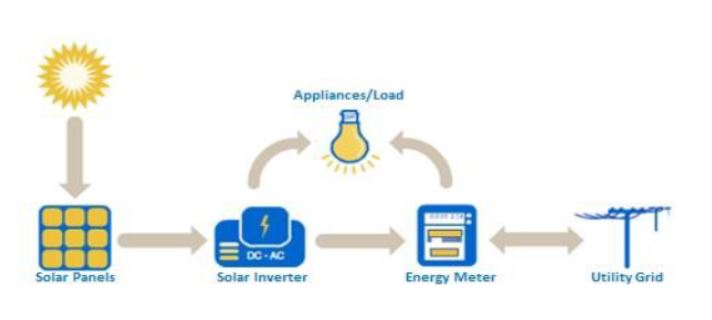
- Inverter: Converts variable DC output from the panels into usable AC power, and synchronizes the generated power with the grid so it can be exported.
- Module mounting structure: The support structure holding the solar PV panels in place for the system's full life, fixed at a particular angle and orientation and built to withstand all weather conditions.
- Bi-directional meter: Records both the generation exported to the grid and the electricity drawn from it — this is what makes net metering billing possible.
- Balance of system: Cables, switchboards, junction boxes, earthing system, circuit breakers, fuses, lightning protection, and other supporting hardware.
Off-grid solar plant components
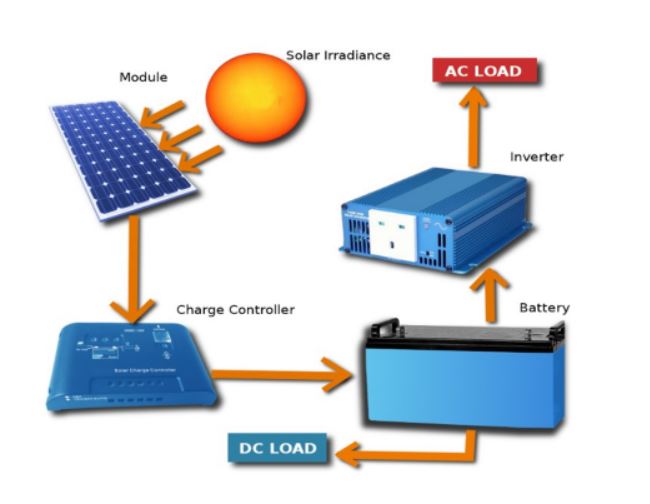
An off-grid plant doesn't need a net meter, but requires these additional components beyond the standard panel and inverter setup:
- Charge controller: A protective device that regulates how much current is fed into the batteries, optimizing their charging and extending battery life.
- Batteries: The battery bank stores generated power and supplies the household load directly, functioning as the system's backup power source.
System comparison
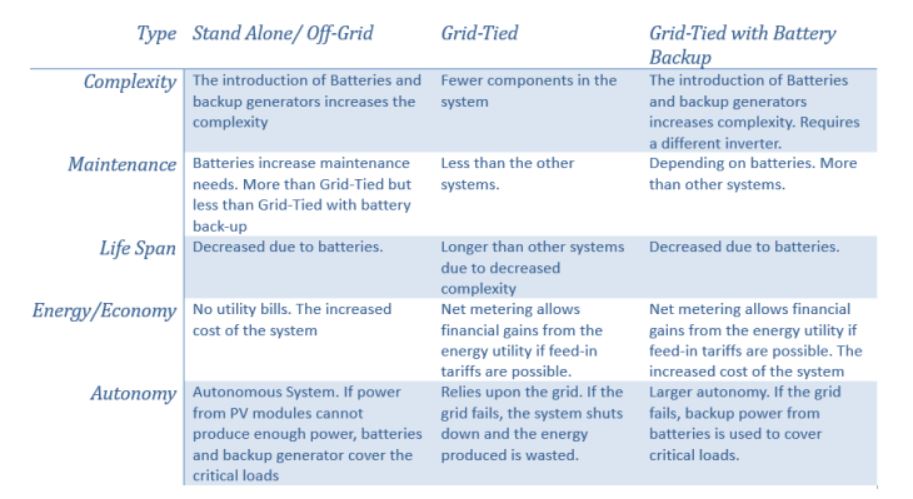
| On-Grid | Off-Grid | Hybrid | |
|---|---|---|---|
| Battery required | No | Yes | Yes |
| Grid connection | Yes | No | Yes |
| Backup during power cut | No | Yes | Yes |
| Net metering eligible | Yes | No | Partial (varies by DISCOM) |
| Relative cost | Lowest | Highest (batteries add cost) | High |
| Best suited for | Areas with reliable grid power | Areas with frequent/long outages, or no grid access | Areas wanting backup + bill savings |
Frequently asked questions
What is net metering and how does it work?
Net metering uses a bi-directional meter to track both the electricity you draw from the grid and the electricity your solar system exports to it. Any surplus you export beyond your monthly consumption carries forward as a billing credit, and is settled through a feed-in tariff at the annual true-up if unused.
Does rooftop solar work during a power cut?
A standard on-grid system shuts down automatically during a power cut due to anti-islanding protection, a safety requirement that prevents the system from feeding power back into a grid that utility workers may be repairing. Only off-grid or hybrid systems with battery backup continue supplying power during an outage.
What's the difference between on-grid, off-grid, and hybrid solar?
On-grid systems are grid-tied with no battery, are the cheapest option, and are eligible for net metering, but provide no backup during outages. Off-grid systems rely entirely on batteries and work independent of the grid. Hybrid systems combine both — a battery for backup plus a grid connection for net metering savings — at a higher cost.
Do I need a net meter for an off-grid solar system?
No. Since an off-grid system isn't connected to the utility grid, there's nothing to net against, so no bi-directional meter is required.
What happens to unused solar export credits at the end of the year?
Most DISCOMs run an annual true-up (commonly in March) where any unused export credits are paid out at a feed-in tariff, typically ₹1–3 per unit, rather than carried forward indefinitely.
Start your journey with an expert team near you!
Helping homeowners on their solar journey!
Have a suggestion for this page? Suggest Edits